The Challenge
Marketing blamed color selection tools. Product development focused on performance claims. Retail partnerships pointed to in-store experience gaps. Customer service cited application issues. Each department had data supporting their theory, but no unified strategy emerged from traditional research approaches.
The Approach
Stakeholder Navigation
Before designing the research, I had to navigate competing departmental priorities. Each team needed different types of insights, and the methodology had to serve three critical audiences simultaneously: Behr’s product teams, retail partners, and Millennial customers.
Longitudinal Behavioral Research Design
As sole researcher — designing, conducting, analyzing, and presenting — I created a research approach that tracked real customer actions over 3-month timeframes instead of relying on traditional survey methods. By following 38 Millennial customers through actual paint projects — from inspiration through purchase, application, and reflection — supplemented by 10 in-depth interviews, the research captured behavior patterns that point-in-time surveys could never reveal.
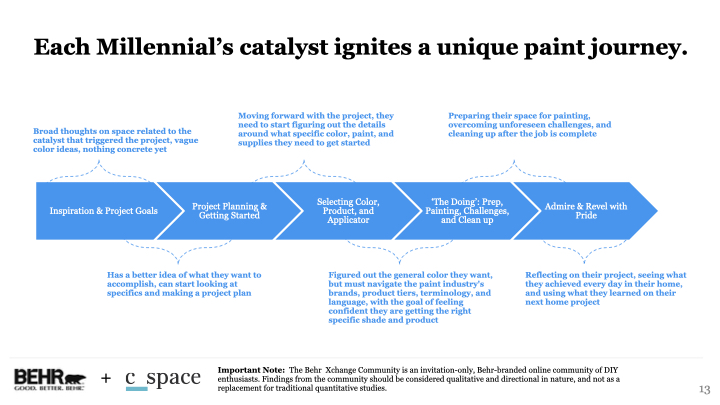
Trust-Based Methodology
Built research relationships that revealed authentic customer behavior. The longitudinal approach meant researchers observed the gap between what customers said they would do and what they actually did — the critical data that all four departments had been missing.
Strategic Synthesis
Transformed raw research data into a prioritized innovation roadmap with clear ROI projections. A cross-departmental alignment workshop used the shared evidence base to end the four-team theory chaos and establish unified strategic direction.
The Results
Before
Four departments defending four theories with partial data. No unified strategy. Traditional research producing more ammunition, not answers.
After
Shared evidence base from longitudinal behavioral research. Cross-departmental alignment. Prioritized innovation roadmap with clear ROI projections.
What Was Delivered
- 3-month longitudinal study tracking 38 Millennial customers through real paint projects
- Strategic synthesis report with prioritized innovation roadmap and clear ROI projections
- Cross-departmental alignment framework and workshop ending four-team theory chaos
- Retail partner sales strategy positioning Behr as Millennial customer experts
- Repeatable research methodology adopted as company standard
What This Demonstrates
The Behr engagement shows the power of longitudinal behavioral research over traditional survey methods. When multiple teams have competing theories backed by partial data, the answer isn’t more data of the same kind — it’s a fundamentally different research approach that captures what customers actually do, not what they say they’ll do. The methodology was valuable enough to be adopted as a company standard for future research.