The Challenge
Leadership had process maps. Operations had workarounds. Sales had customer promises. IT had system flows. Each department operated with partial visibility, making strategic decisions based on assumptions about what actually happens from order to delivery.
The Approach
Ethnographic Immersion
Instead of interviewing teams about their work, I was embedded in warehouse operations for one week. I followed the full chain: from digital touchpoints like order placement, to when orders hit the warehouse computer system, to the backend actions triggered for warehouse workers, to how they pick and stack tires for loading various-size trucks for local and national delivery — all the way to customer doorstep. This immersion documented actual workflows, informal systems, and hidden handoffs — the things teams do but never write down because “that’s just how it works.”
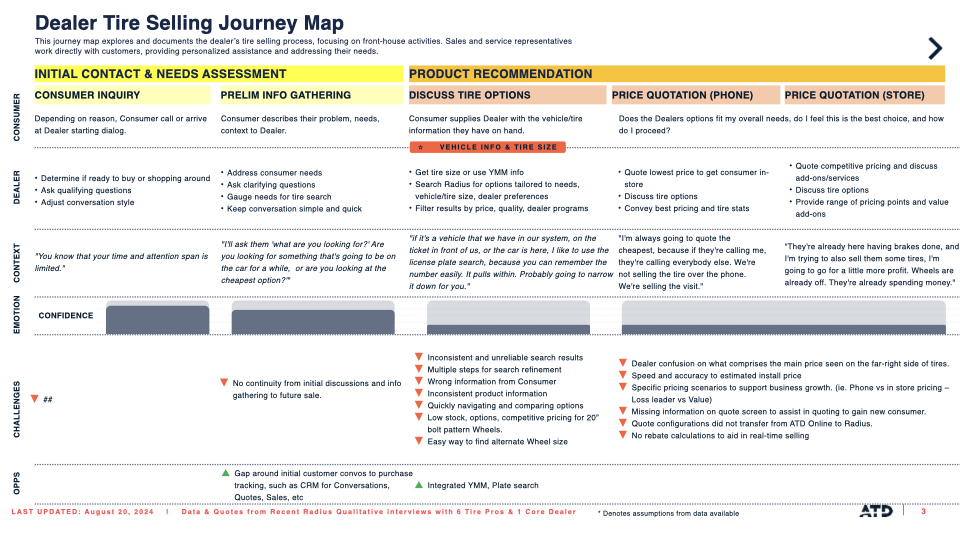
End-to-End Mapping
Connected all touchpoints across departments into a unified operational reality. From digital order placement through delivery completion, the service blueprint captured every handoff, workaround, and informal process that shaped the actual customer experience.
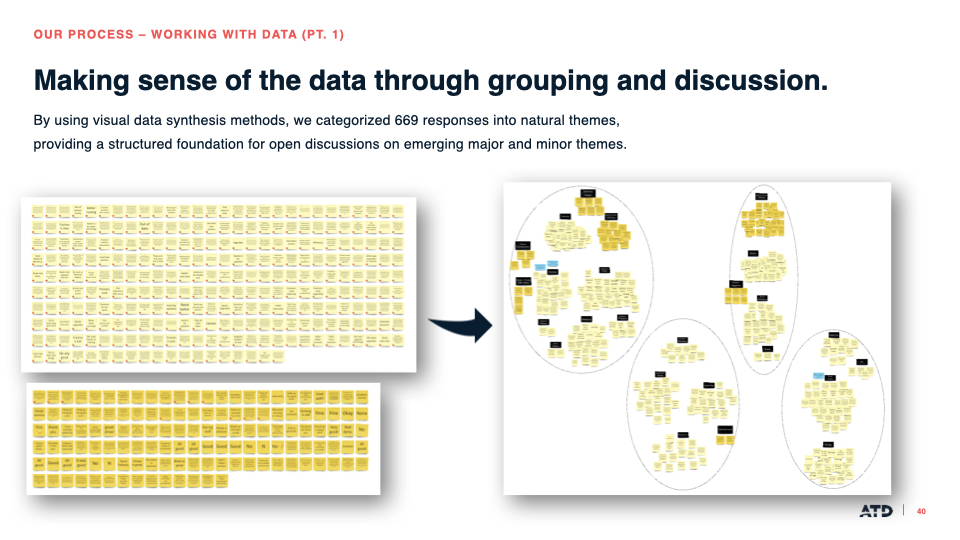
Cross-Functional Alignment
Used the service blueprint as a foundation for strategic workshops. When all five departments could see the same operational reality for the first time, the conversation shifted from defending assumptions to collaborating on improvements.
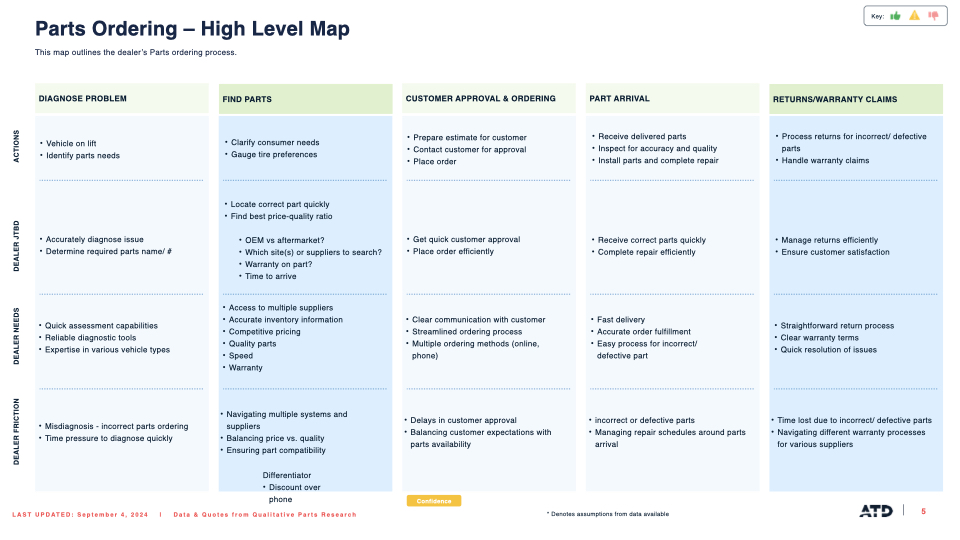
The Results
Before
Five departments with five versions of reality. Strategic decisions based on assumptions. No shared understanding of the actual customer journey.
After
Unified service blueprint documenting real workflows. Shared operational truth. Cross-functional improvement planning based on evidence.
What Was Delivered
- 1-week immersion study documenting complete customer and employee experience across all operational touchpoints
- Comprehensive service blueprint revealing actual workflows, system handoffs, and informal processes
- Stakeholder alignment foundation replacing five departmental assumptions with unified operational truth
- Strategic workshop framework using shared reality for cross-functional improvement planning
- Immersion methodology template adopted for future operational discovery projects
What This Demonstrates
The ATD engagement demonstrates the value of immersion-based research over interview-based discovery. When organizations have operated with separate versions of reality for long enough, interviews only surface what people believe happens — not what actually happens. The 1-week warehouse immersion captured the informal systems, hidden handoffs, and undocumented workarounds that no interview could reveal. The methodology was valuable enough to be templated for future use.