The Challenge
Apple’s App Store team faced a disconnect: users appeared to be ignoring ads based on traditional engagement metrics, but those same “ignored” ads were somehow driving purchases. The team needed to understand what was really happening in the user journey.
The Approach
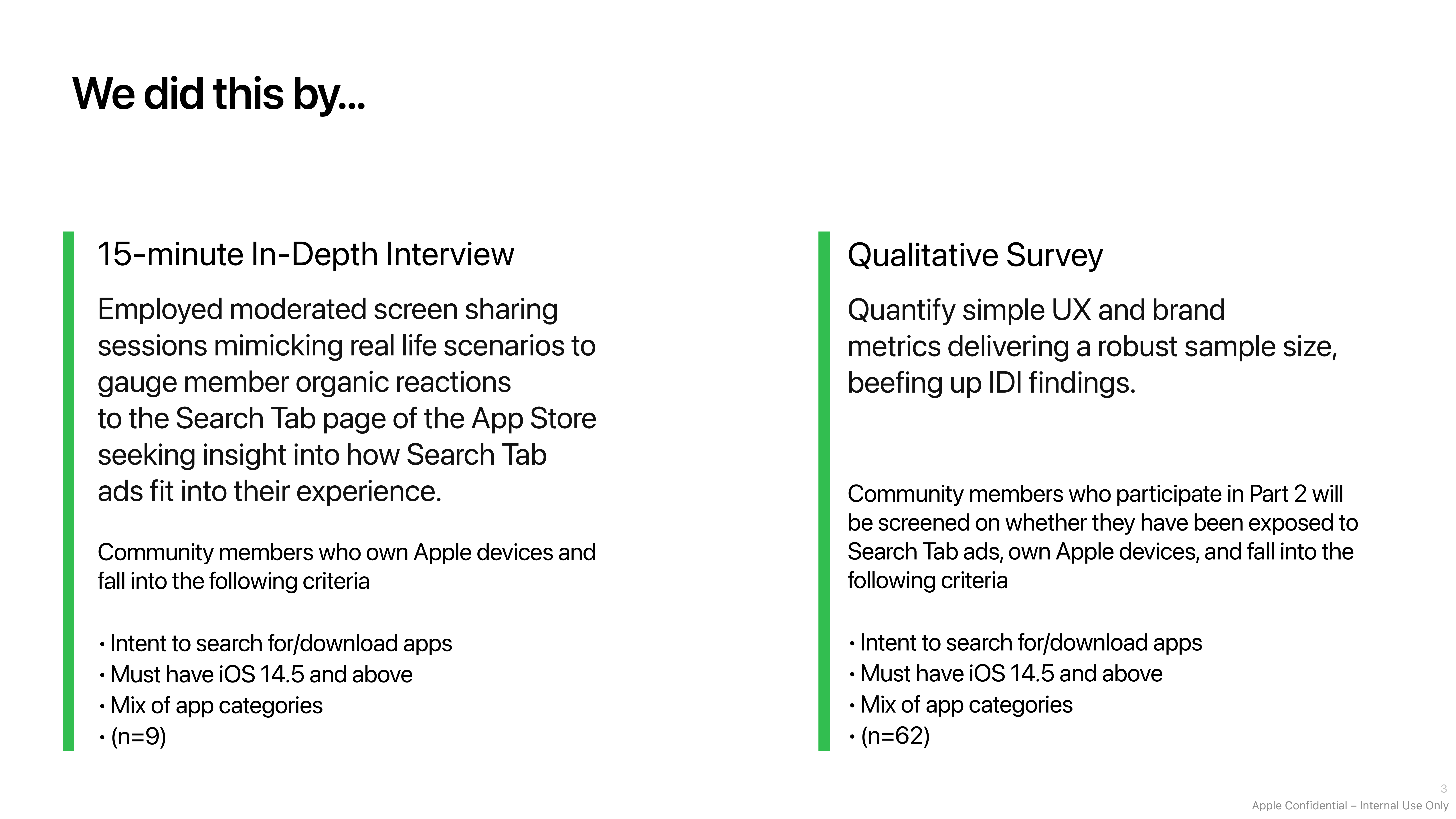
Reframing the Research Question
Instead of focusing on traditional engagement metrics, we designed a study to capture the complex relationship between Apple’s user personas and their actual mindsets within the App Store. The question shifted from “are users engaging with ads?” to “how does ad exposure shape the path to purchase?”
Behavioral Research Design
Studied motivations from navigation to existing relationships with the App Store ecosystem. By tracking the full context of user behavior — not just the moment of ad exposure — we uncovered how ads significantly influenced both immediate interactions and long-term engagement patterns.
Stakeholder Translation
Facilitated workshops translating research findings into actionable implementation strategy. The research challenged existing assumptions about ad performance, requiring careful framing to help stakeholders see the opportunity rather than feel defensive about previous metrics.
The Results
Before
Engagement metrics showed users 'ignoring' ads. Teams optimizing for the wrong signals. Potential ad revenue undervalued.
After
Behavioral research revealed hidden influence patterns. Ad exposure connected to actual purchase decisions. Strategy reshaped around real user behavior.
What Was Delivered
- Behavioral research connecting ad exposure patterns to actual purchase decision points
- User journey analysis revealing hidden influence of “ignored” advertising content
- Stakeholder workshops translating research findings into actionable implementation strategy
- Executive presentation delivering findings directly to Apple leadership team
What This Demonstrates
The Apple engagement illustrates a common trap: optimizing for measurable engagement while missing actual influence. Traditional metrics captured clicks and taps but missed the cognitive impact of exposure. What looked like “ad blindness” was actually sophisticated filtering behavior — users processing ads subconsciously, with that exposure directly influencing purchase decisions 2-3 steps later. By studying the full user journey rather than isolated touchpoints, the research revealed that the ads were working — just not in the way existing metrics could show. This kind of behavioral insight requires research design that goes beyond traditional analytics to capture what’s really happening.